%20(18).png)


When a major artist comes to town, most property managers do the same thing: they nudge rates up slightly, wait for occupancy to move, and treat the weekend like a seasonal holiday.
Concert tourism is not seasonal demand. It is a compressed demand shock; emotionally driven, date-fixed, and often dramatically less price-sensitive than traditional leisure travel. Markets don’t just lift during major concerts; in many cases, they distort.
Consider a single-night stadium performance in College Station, Texas. During the George Strait concert weekend, the highest attended concert at that time, ADR increased 128% year-over-year. Revenue per property rose 239%. Reservations per property surged 208%. At the same time, average length of stay declined nearly 40%, signaling concentrated one-night demand. That is not holiday behavior, that is event compression.
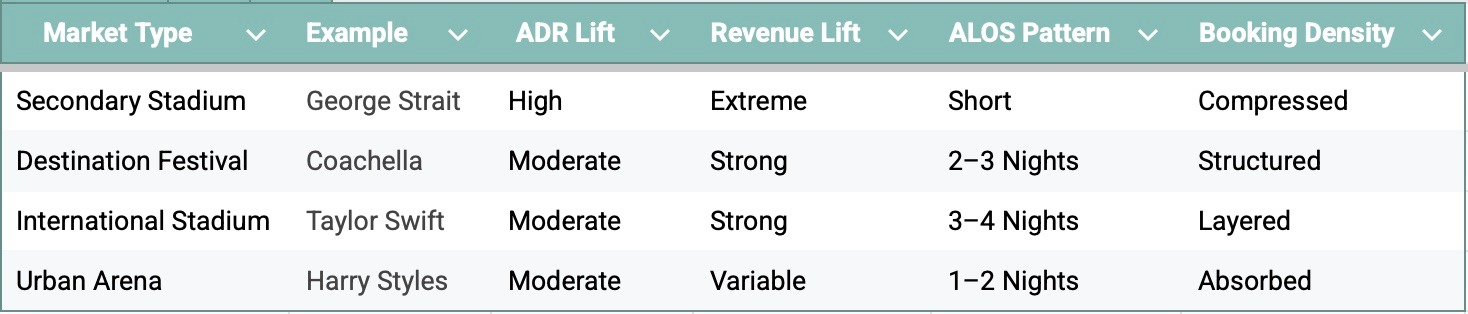
Across international stadium tours in London, England, destination festivals in Indio, CA, and arena performances in New York City, NY, performance data reveals a consistent pattern: managers who recognize the mechanics of concert-driven travel capture outsized returns. Those who apply holiday logic leave meaningful revenue behind.
Don’t Price Like a Holiday, Price for Elasticity
Holiday demand is broad and predictable. Concert demand is fixed, emotional, and constrained by venue capacity. In London during Taylor Swift’s multi-night stadium run, ADR increased 8.6% year-over-year, yet revenue per property climbed 24%. In New York City during Harry Styles’ arena performances, ADR is pacing 32% ahead, driving a 361% increase in revenue per property from last year. In Indio during Coachella Weekend 1, revenue per property increased 291% week-over-week, rising from $449 the prior weekend to $1,758 during the festival. Occupancy jumped from 28% to 59%, an increase of 111%.
The mistake many managers make is waiting for visible occupancy compression before adjusting rates. By the time listings are nearly full, pricing opportunity has already peaked. Be sure to have your pricing strategy ironed out well in advance of when tickets go on sale.
Demand Moves in Waves, Not Lines
Concert bookings rarely accumulate steadily. They arrive in identifiable surges.
Secondary stadium markets often see late compression. In College Station, reservations per property increased more than 200%, indicating tight booking density within compressed windows.
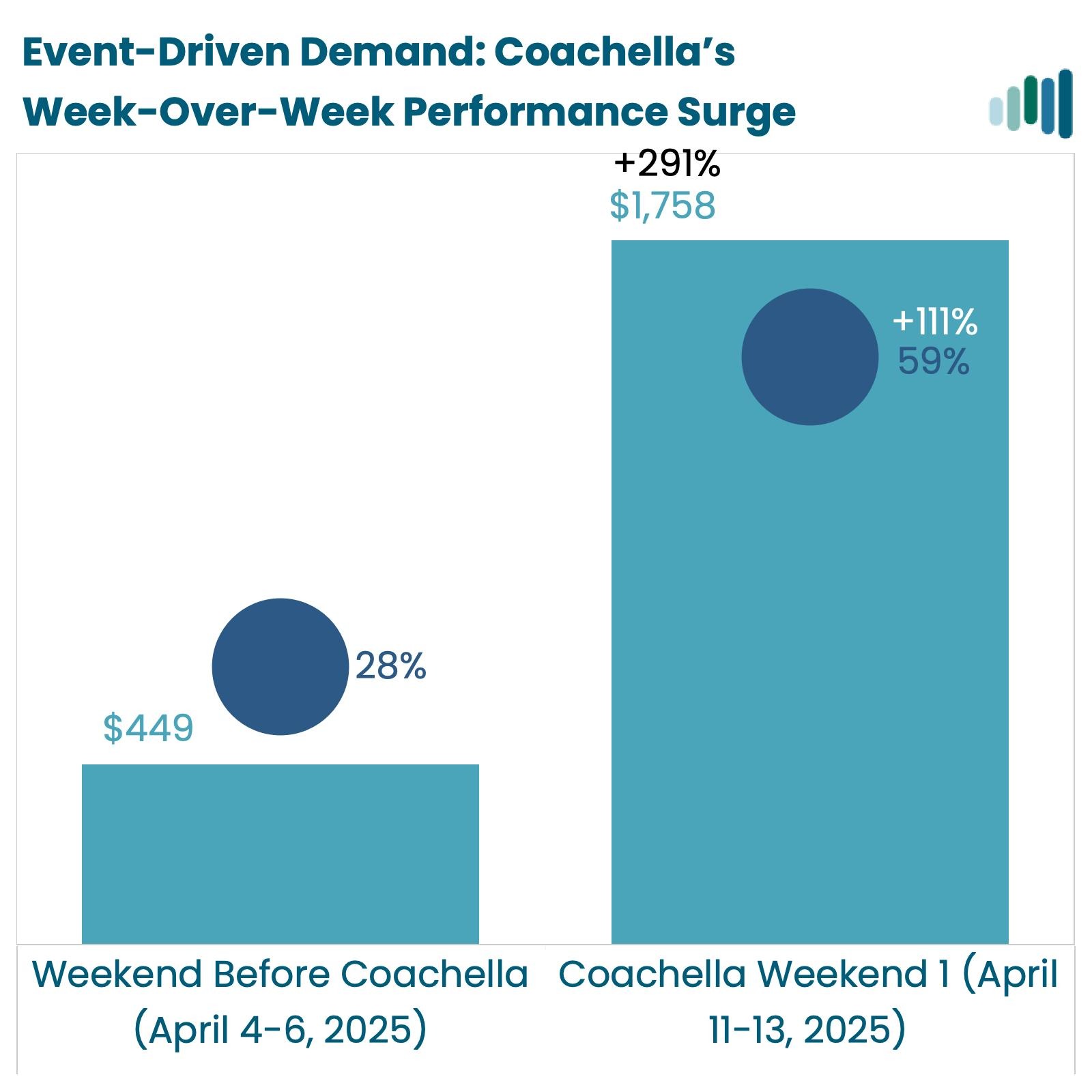
Coachella demonstrated strong week-over-week lift without erratic volatility, reflecting coordinated, planned travel patterns.
International stadium markets layer early and late waves. Urban arena markets absorb demand more gradually but still exhibit sharp ADR acceleration.
The lesson is operational: monitoring pace weekly is insufficient. Concert markets move daily, and often accelerate sharply inside 30 days. Managers who track booking velocity in real time can adjust pricing in rhythm with demand instead of trailing it.
Minimum Stay Policies Should Reflect Market Structure, Not Habit
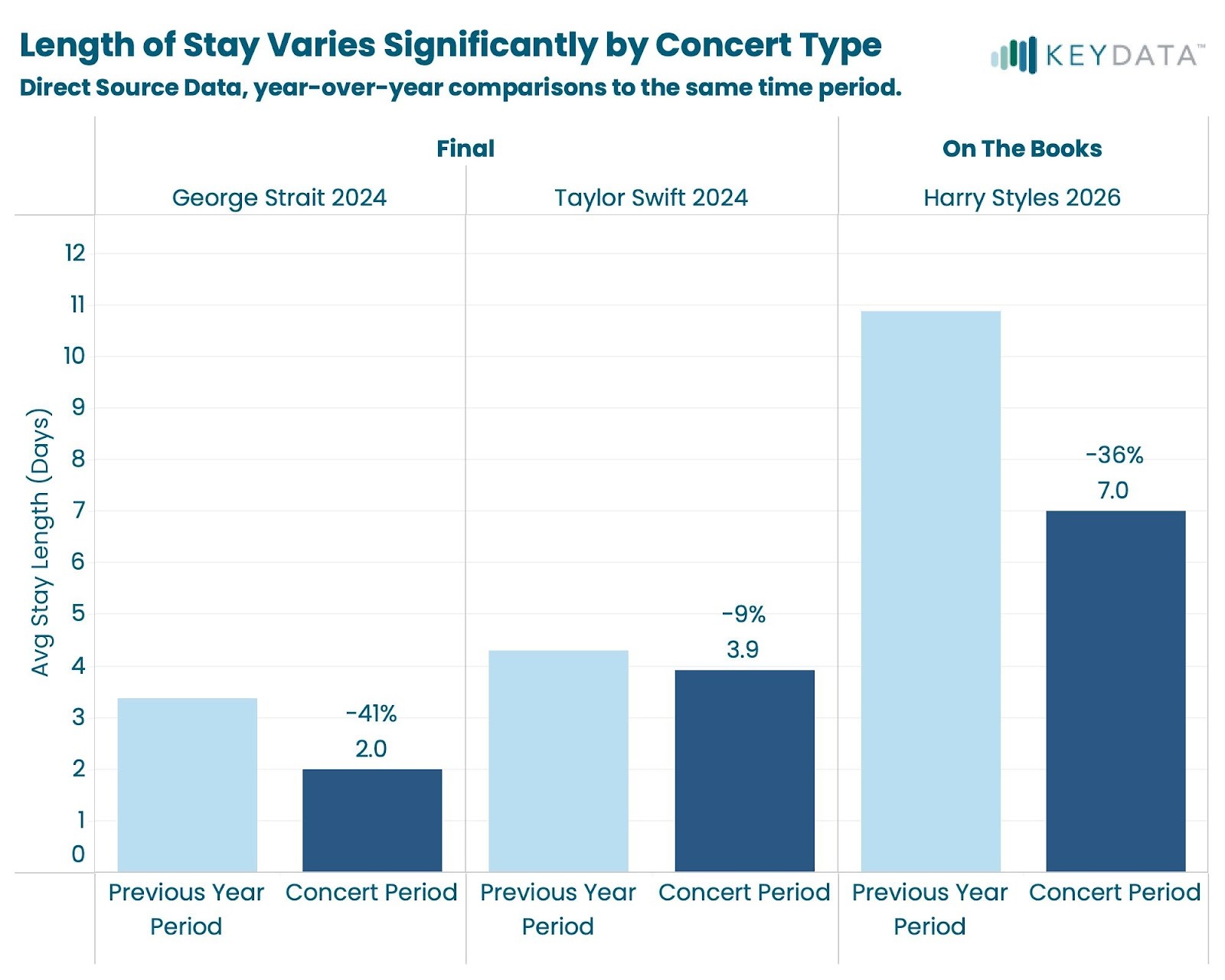
In College Station, average length of stay declined nearly 40% year-over-year during the George Strait concert, signaling heavy single-night demand. Restrictive minimums in markets like this risk suppressing booking velocity and leaving gaps.
In Indio, average length of stay held near 2.85 nights during Coachella, supporting multi-night policies. In London, average stays approached four nights, reflecting international travel behavior.
The appropriate minimum stay policy depends less on personal preference and more on traveler origin and venue type. Drive-to stadium markets skew short. Destination and international events skew longer.
Concert Guests Are Operationally Different
Revenue lift is only part of the story. Operational intensity rises as well. In College Station, the 208% increase in reservations per property dramatically increased turnover density. While guest nights rose 49%, the sharper reservation growth indicates shorter stays and more frequent cleanings.
Concert guests are date-committed. Once tickets are secured, cancellation risk declines. Travel windows are fixed. Arrival clustering tightens. Managers who plan staffing and communication accordingly avoid operational strain, and capitalize on concentrated demand instead of reacting to it.
Don’t Overestimate Cancellation Risk, But Don’t Ignore It
Concert demand tends to stabilize once bookings are secured. Markets that saw significant ADR lift, including the 128% increase in College Station, did not experience corresponding occupancy collapse. Similarly, Coachella’s 291% week-over-week revenue surge held alongside strong occupancy gains.
While weather and rare event cancellations remain real risks, aggressive discounting inside the final booking window often reflects fear rather than data. Concert demand, once committed, is durable.
Revenue Optimization Requires a Timeline
Concert performance outcomes across all four markets share one theme: pricing strategy timing determines magnitude.
Revenue per property increased:
- 239% year-over-year in College Station
- 291% week-over-week in Indio
- 24% year-over-year in London
- 361% year-over-year in New York City
These results were not uniform in structure, but they were consistent in one respect: markets where pricing aligned with compression saw outsized returns.
Successful managers identify major events early, adjust base rates 60+ days out, monitor booking waves inside 30 days, and refine strategy inside 14 days.
Concert weekends are predictable, but only if approached deliberately.
The Most Common Mistakes
The data highlights recurring missteps:
- Treating concert weekends like seasonal holidays
- Waiting for visible sellout before raising rates
- Applying rigid minimum stays without market context
- Over-discounting inside final booking windows
- Ignoring how venue type shapes demand
Concert tourism is not random volatility. It is structured, repeatable, and measurable.
The managers who win are not simply lucky enough to host during a major event. They understand how event-driven demand behaves, and price accordingly.