



With the release of the 2026 FIFA World Cup schedule, hotel demand is already beginning to materialize across host and adjacent markets. As of January 22, 2026, year-over-year hotel performance for the World Cup period shows clear signs of early pickup, particularly in markets closely tied to match locations.
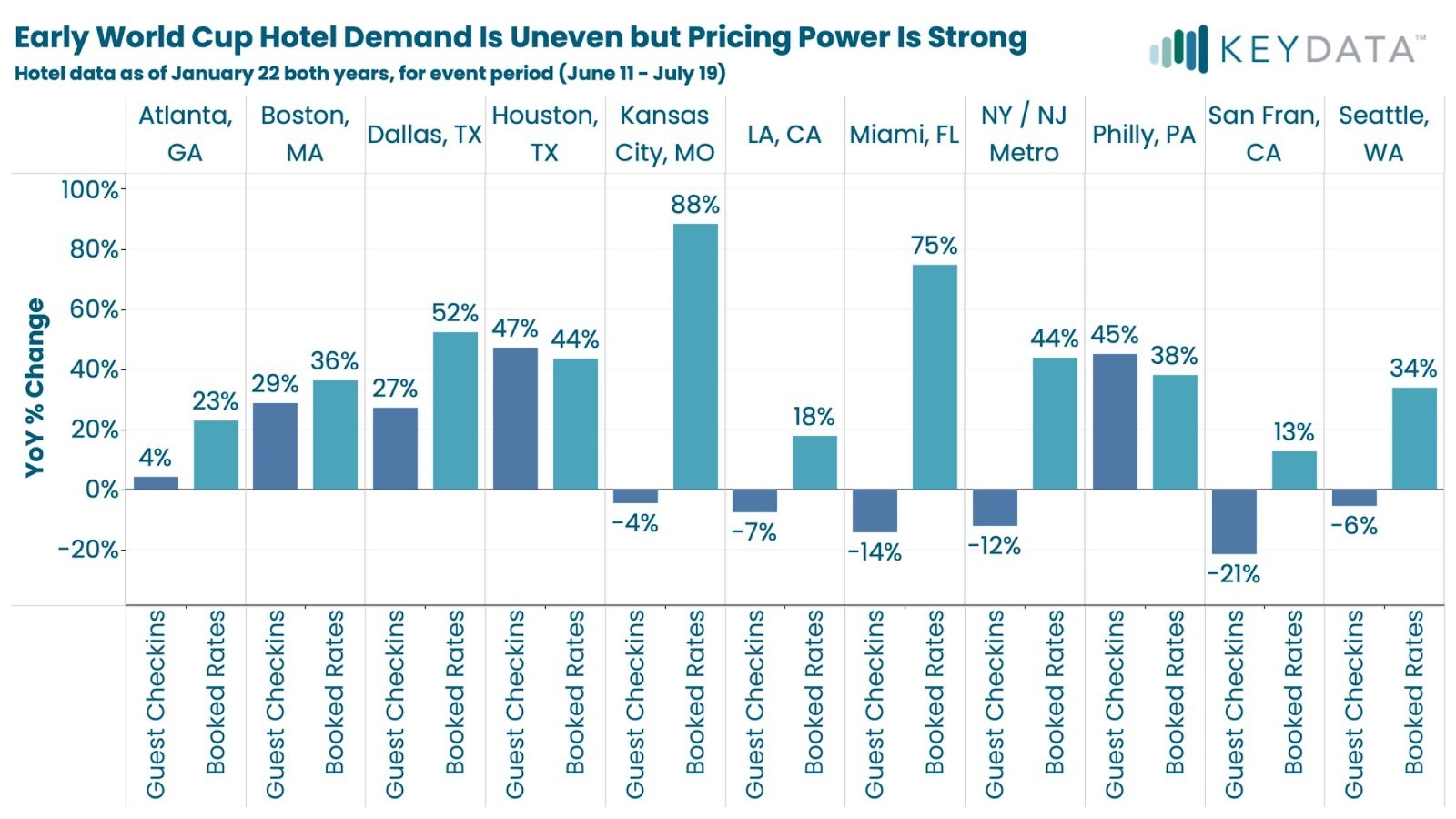
Several markets are seeing meaningful growth in check-ins compared to the same time last year. Houston is up more than 47%, Boston nearly 29%, and Dallas–Fort Worth roughly 27%. At the same time, hotels are demonstrating strong pricing power. Year-over-year ADR growth ranges from the high teens to well over 50%, with Dallas–Fort Worth leading at more than a 52% increase and Boston close behind at over 36%.
Despite these encouraging signals, occupancy levels remain relatively low across markets, generally below 7% for the World Cup window. This reflects how far out bookings still are, rather than a lack of interest, but it also highlights that the market has not yet fully compressed. In other words, early demand is real, but the bulk of booking activity is still ahead.
Booking behavior further reinforces why hotels are structurally well-positioned for this event. Average lengths of stay across markets cluster tightly between roughly 2.5 and 3.2 nights, closely aligning with match-based travel patterns. Booking windows remain long and largely unchanged year over year, suggesting that travelers who want to plan early are already doing so, while others will enter the market later as match dates approach.
For hoteliers, this creates both opportunity and risk. Strong early pricing power can tempt operators to overcommit inventory or discount too aggressively before demand fully materializes. At the same time, rigid pricing or inventory strategies can limit the ability to capture late-stage travelers who are displaced from other lodging options or finalize plans closer to match dates.
How Hoteliers Can Prepare for World Cup and Major Event Travel
- Protect pricing power early. Event-driven demand often books far in advance but compresses closer to match dates. Avoid over-discounting early inventory and preserve flexibility to capture late-stage demand.
- Plan for short, high-turnover stays. World Cup travel typically centers on two- to three-night trips. Ensure operations, staffing, and housekeeping are ready for increased turnover rather than extended stays.
- Manage inventory release strategically. Phasing inventory into the market helps balance early demand with the opportunity to capitalize on last-minute travelers and displaced guests.
- Optimize shoulder nights. Pre- and post-event nights often represent incremental revenue opportunities. Target pricing and promotions to extend stays without relying on peak match nights alone.
- Monitor pickup, not just pace. Use real-time pickup trends rather than historical seasonality to guide pricing and availability decisions as match dates approach.
- Communicate convenience clearly. As rates rise across the market, travelers place greater value on clarity around location, transportation access, and match-day logistics.
- Prepare for substitution effects. As short-term rentals tighten availability or restrict length of stay, hotels are likely to capture additional demand — particularly from short-stay and last-minute travelers.
The World Cup is not a single demand surge but a sequence of compressed peaks tied to specific matches. Hotels that preserve flexibility, maintain pricing discipline, and pay close attention to pick up patterns as the event approaches will be best positioned to capture the full revenue opportunity. Early demand is an encouraging signal, but execution over the coming months will determine which properties truly benefit.