%20(17).png)


When a major artist comes to town, it is easy to treat the weekend like a holiday. You expect a lift, you plan for a crowd, and you move on.
But concert travel is not seasonal demand. It is a compressed demand shock. It is emotionally driven, locked to a specific date, and constrained by venue capacity. That combination changes how visitors book, how long they stay, and how concentrated arrivals become.
For destination marketing organizations, that matters because the impact goes well beyond lodging performance. Concert weekends affect traffic, staffing, visitor services, partner communication, and how smoothly the destination runs.
Concert tourism does not just lift demand, it reshapes it
A single-night stadium show can compress travel behavior into a tight window.
In College Station, Texas during the George Strait concert weekend, reservations per property surged 208% year-over-year. At the same time, average length of stay declined nearly 40%. That is not a typical “busy weekend.” That is a one-night concentration that creates a very different operational reality across hotels and vacation rentals.
When demand compresses like this, the destination experiences:
- More arrivals in a shorter timeframe
- More one- and two-night trips
- Higher turnover and more check-ins
- Heavier strain on roads, parking, and visitor services
This is why event weekends can feel chaotic even when the destination “planned” for high volume. The issue is not just volume, it is compression.
Do not manage concert weekends like holidays, manage them like capacity events
Holiday travel is broad and predictable. Concert travel is date-fixed and capacity-limited.
That difference changes the playbook for a destination. The goal is not just to be ready for more visitors. It is to keep the visitor experience smooth while protecting the resident experience.
For DMOs, this starts with planning around the event timeline:
- When tickets go on sale
- When bookings start to surge
- When arrivals cluster
- When departure peaks create traffic pinch points
When you plan around those moments, you can coordinate messaging, transportation guidance, staffing, and partner readiness before the crunch hits.
Demand moves in waves, not in a straight line
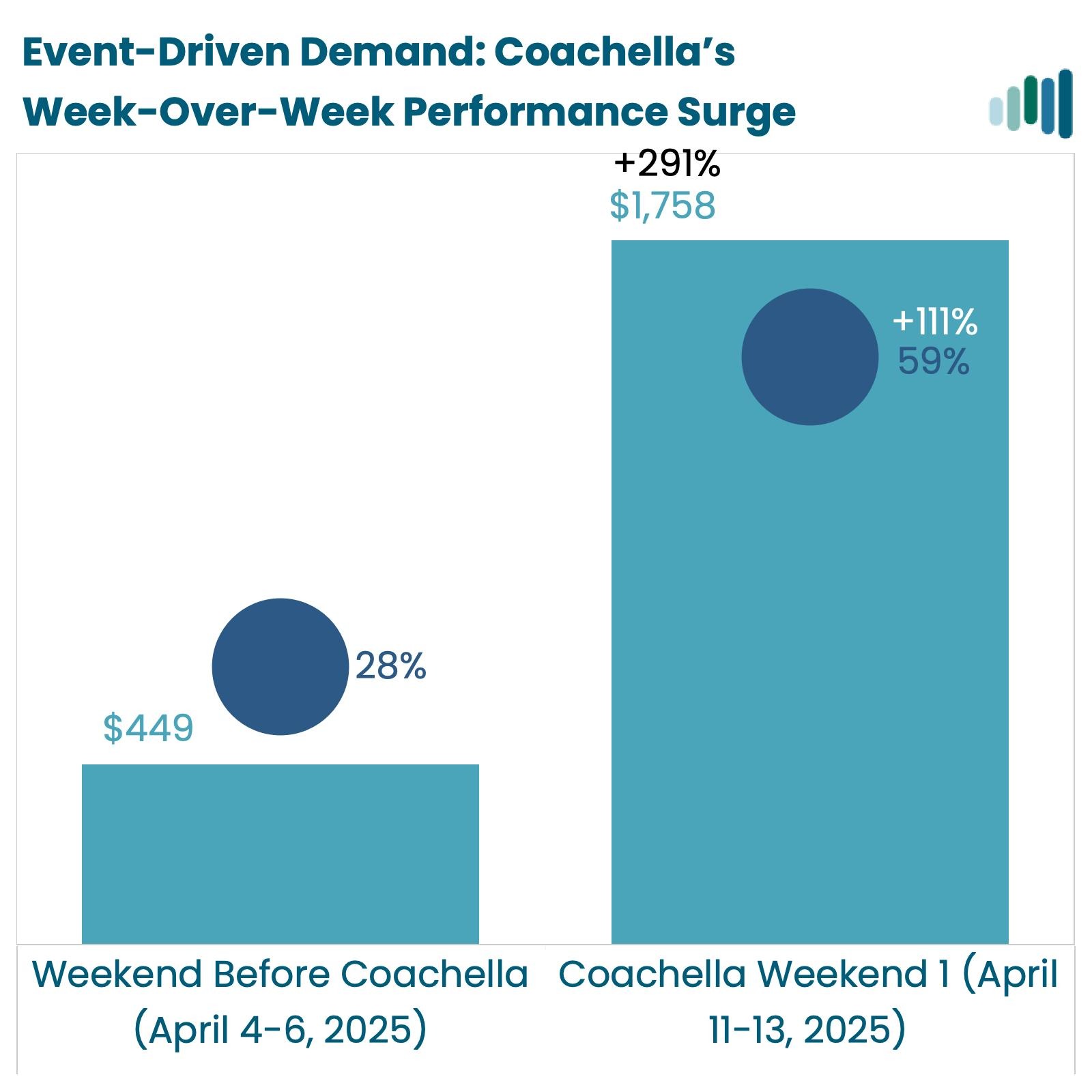
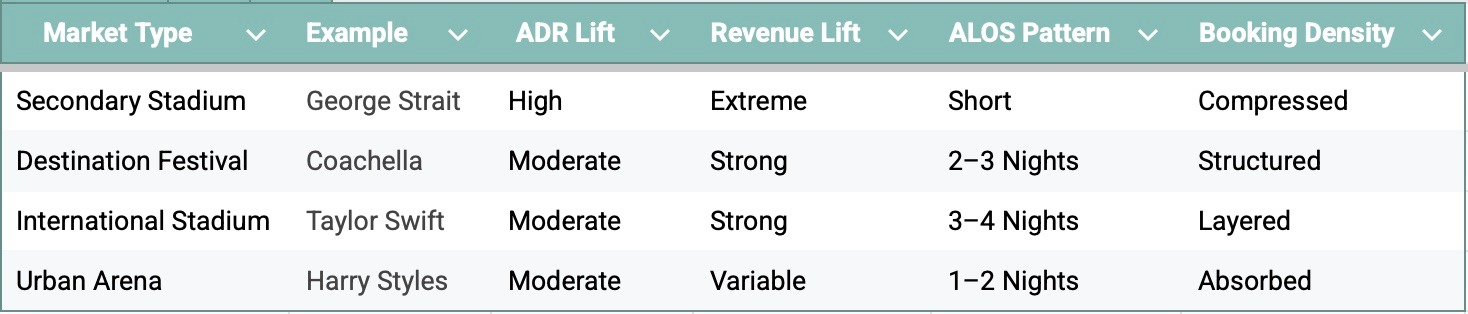
Concert bookings rarely build steadily. They come in recognizable surges, and the pattern changes by market type:
- Drive-to stadium markets often compress late, with sharp spikes inside the final 30 days.
- Destination festival markets can show coordinated lift across multiple weeks.
- International tour stops often have both early waves and late waves, especially when travelers are flying in and building longer itineraries.
The lesson for DMOs is simple: Event travel can change meaningfully day to day, especially inside 30 days. So, it’s essential to access real-time data.
If you can monitor pacing frequently, you can make smarter calls on when to amplify last-minute messaging.
Length of stay is a destination strategy lever, not just a lodging metric
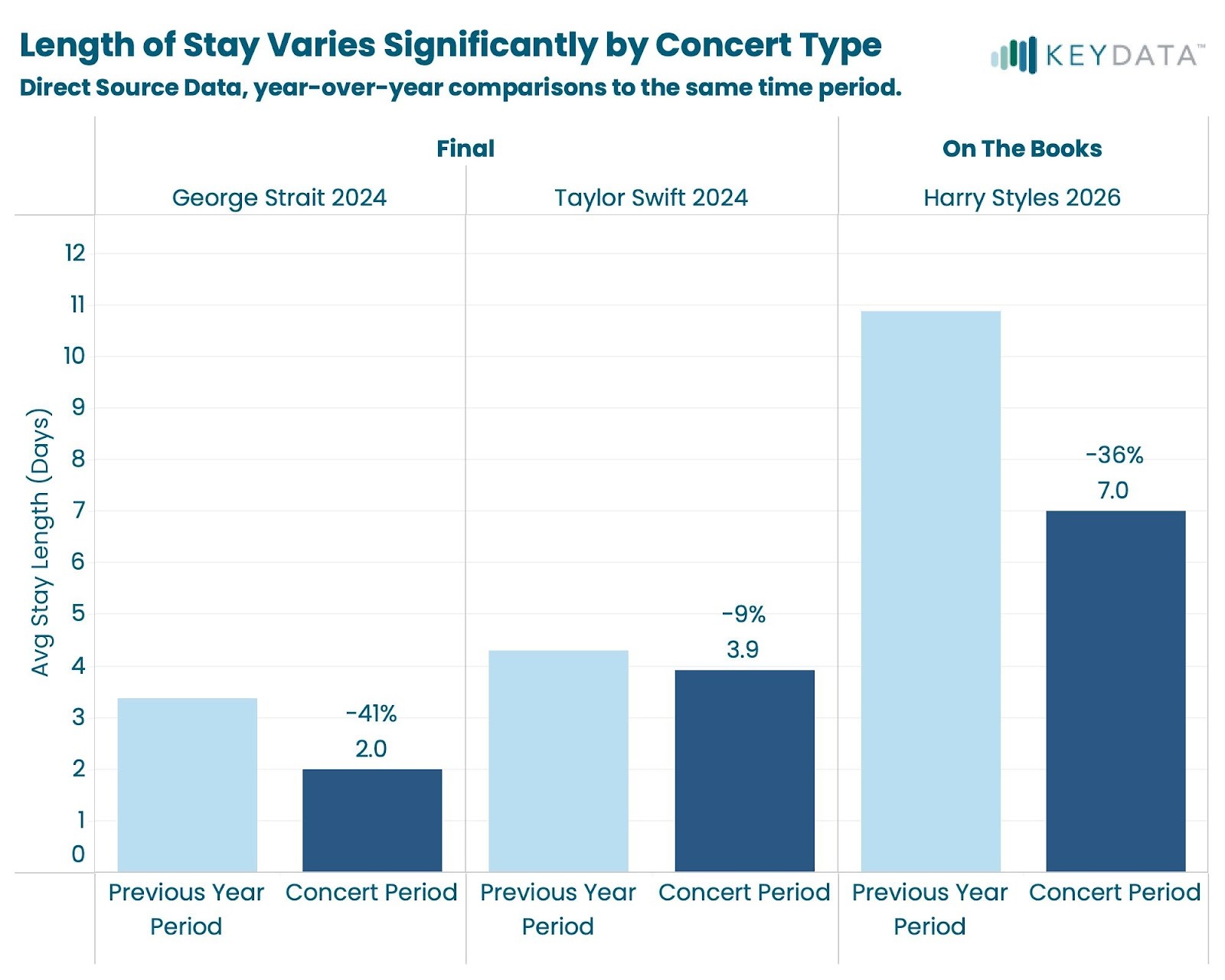
Length of stay tells you what kind of visitor behavior the event is creating.
- In drive-to stadium markets like College Station, the length-of-stay drop signaled heavy single-night behavior.
- In destination events like Coachella, average length of stay held close to 2.85 nights, which supports multi-night visitation patterns.
- In international stadium markets, stays can stretch longer, closer to four nights, reflecting longer-haul travel behavior.
This is where DMOs can move from reporting to action.
If your market skews to one-night stays during major events, you can test “add-a-night” strategies that make the experience better and reduce pressure on the destination, such as:
- Pre-show itineraries that highlight neighborhoods beyond the venue area
- Post-show experiences that encourage a second night
- Midweek extensions tied to local attractions, outdoor recreation, or culinary experiences
Longer stays typically mean fewer turnover surges, a smoother flow of visitors, and more time for travelers to engage with the destination beyond the event.
Concert guests behave differently, and the destination feels it
Event travelers are date-committed. Arrival windows are tight. Check-in volume stacks up. Turnover density rises because stays are often shorter.
That creates operational intensity across the visitor economy.
DMOs can reduce friction by using forward-looking visibility to align partners early, including:
- Weekly visitor forecasts that help businesses staff appropriately
- Clear guidance on peak arrival days, peak departure days, and traffic expectations
- Visitor communications that set expectations on parking, transit options, and best times to travel
When partners can prepare, service improves. When service improves, visitor sentiment improves. That is how an event becomes a positive story, not a stress test.
Cancellation risk is usually lower than people assume, but it is not zero
Once tickets are purchased and lodging is booked, concert travel tends to hold. Visitors are committed to the date, and plans are less flexible.
That does not mean there is no risk. Weather, rare cancellations, and travel disruptions can still happen. The difference is that DMOs can usually plan with more confidence than they would for loosely motivated leisure travel.
Instead of reacting with uncertainty, focus on building a simple contingency plan:
- A messaging plan if the event changes
- A partner update process
- A way to monitor bookings and check-ins in real time as conditions change
The destination playbook: build an event timeline, not a post-event report
The destinations that get the most value from major events are not just measuring what happened. They are managing what is about to happen.
A practical event timeline can look like this:
60+ days out
- Identify the likely booking wave based on past events
- Align with hotel and vacation rental partners on expectations
- Confirm visitor services and transportation plans
30 days out
- Monitor booking acceleration and short-lead trends
- Adjust marketing and communications to support shoulder days and dispersal
- Begin partner forecasts to support staffing and operations
14 days out
- Tighten visitor messaging on parking, transit, arrivals, and departures
- Confirm weekend staffing plans and peak-day support
Post-event
- Measure impact across hotels and vacation rentals
- Review feeder markets and booking windows
- Capture learnings for future bids, grant reporting, and stakeholder updates
The most common destination mistakes
Concert weekends are predictable, but only if you treat them deliberately. The most common mistakes DMOs make include:
- Treating the weekend like a seasonal holiday instead of a capacity-driven demand shock
- Waiting too long to align partners on expected arrival and departure peaks
- Ignoring how length of stay shifts by event type and traveler origin
- Focusing only on a citywide number and missing neighborhood-level strain
- Reporting performance after the fact instead of using pacing to manage the destination in advance
Why this matters now
Major event travel are not random volatility. They are structured, repeatable, and measurable. Beyond concerts, destination marketers can apply these strategies to maximize major events in their area. In 2026, destinations should keep a close eye on events such as the World Cup and the America 250 celebration, as the same principles of concert tourism apply.
When DMOs can see event-driven demand forming early across both hotels and vacation rentals, they can act early, align stakeholders, and keep the destination running smoothly, even on the busiest weekends.