
.png)


The July 4th holiday weekend remains one of the clearest indicators of summer tourism demand in the United States, and the 2026 results offer encouraging signals for destination marketing organizations heading into the summer travel season. KeyData analyzed vacation rental pacing performance across 25 U.S. markets, comparing the Friday–Monday holiday window in 2026 (July 3–6) against the equivalent Friday–Monday holiday period in 2025 (July 4–7).
Key Takeaways
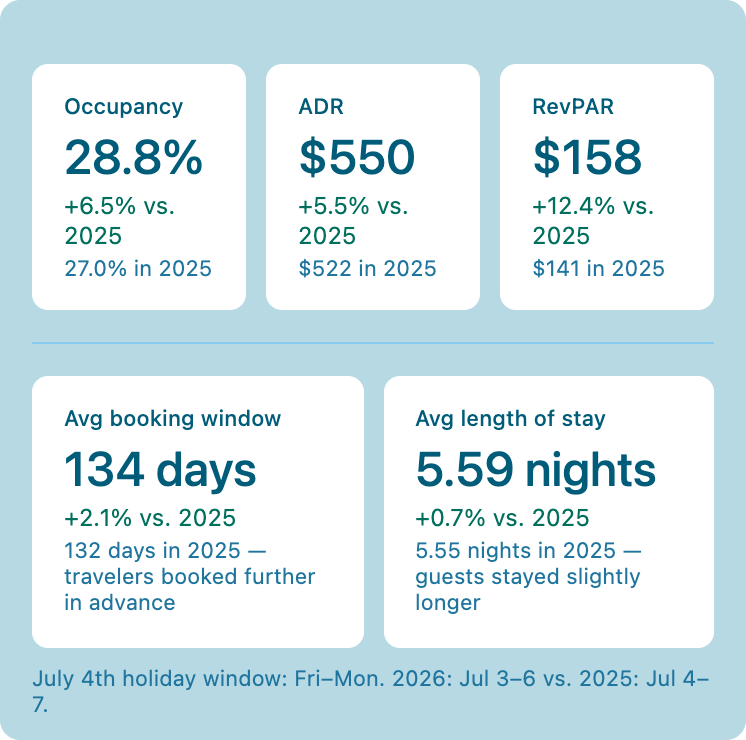
- National occupancy is pacing 6.5% ahead year over year during the July 4th holiday weekend.
- Travelers are booking 2.1% earlier nationally compared to 2025.
- Average length of stay is increasing from 5.55 nights to 5.59 nights.
- Twenty-two of 25 markets analyzed are showing RevPAR growth during the holiday period.
National Travel Demand Is Remaining Strong
Nationally, the July 4th holiday period is reflecting a healthy and resilient leisure travel environment. Occupancy is pacing 6.5% ahead year over year, indicating that a larger share of available inventory was booked during the holiday weekend compared to the same travel window in 2025.
For destination marketing organizations, occupancy growth remains one of the clearest indicators of visitor demand and overnight travel activity. The widespread occupancy gains recorded across the majority of markets analyzed suggest travelers continue to prioritizing leisure trips during peak summer travel periods despite ongoing economic uncertainty and changing consumer behavior.
Average length of stay is also increasing modestly year over year, rising from 5.55 nights to 5.59 nights. Although incremental, longer stays can materially increase visitor spending across restaurants, attractions, retail, and local tourism businesses, particularly during high-demand holiday periods.
Travelers Are Planning Trips Earlier Than Last Year
One of the most important behavioral trends from the July 4th data was the increase in booking windows nationally. Travelers are booking holiday trips 2.1% further in advance compared to 2025, with the average booking window increasing from 131.5 days to 134.2 days.
For DMOs, booking window trends provide valuable insight into traveler confidence and trip-planning behavior. Longer booking windows typically indicate stronger destination intent, earlier travel inspiration, and increased willingness among travelers to commit to leisure trips further ahead of arrival.
At the market level, booking behavior varies significantly. New England is recording the largest booking window increase in the dataset at 14.7%, while average length of stay is increasing 6.7%. Those trends suggest travelers are not only planning trips earlier, but also committing to longer vacations in the region during the holiday period.
By contrast, U.S. Territories are seeing booking windows compress 27.5% year over year, while average length of stay is down 23.3%. Eagle County, Colorado is also experiencing shorter booking windows and shorter stays for the holiday. These trends reinforce that traveler behavior continues to evolve differently across destination types and regions.
Mid-Atlantic and Coastal Markets Are Leading Occupancy Growth
Several coastal and regional drive-to markets are significantly outperforming national averages during the holiday weekend.
Mid-Atlantic States are showing the strongest occupancy growth in the dataset with occupancy increasing 19.5% year over year. Worcester County, Maryland is also recording occupancy growth of 10.7%, reinforcing the continued strength of traditional East Coast beach destinations during peak summer travel periods.
Florida destinations are also performing well throughout the holiday window. Bay County, Florida is showing an occupancy growth of 15.2%, while Osceola County is up 7.9% year over year for occupancy.
This pacing data reflects a broader trend that continues shaping U.S. tourism demand: travelers remain highly engaged with accessible leisure destinations that offer flexible accommodations, strong family appeal, and regional drive-market convenience.
Interior and Regional Destinations Are Also Performing Well
Strong travel demand is not limited solely to coastal vacation markets. The Midwest U.S. is showing occupancy growth of 16.4% year over year, while Central States are increasing occupancy 12.4%.
Western U.S. and West Coast States are showing double-digit occupancy gains during the holiday weekend, demonstrating that strong demand is extending across a wide range of destination types and geographic regions.
For DMOs, the breadth of occupancy growth across so many market categories is an encouraging signal that leisure demand remains broadly healthy entering the summer season.
What Booking Window Trends Mean for Destination Marketers
The variation in booking window behavior across markets carries important strategic implications for destination marketing organizations.
Markets experiencing longer booking windows may benefit from earlier seasonal campaigns focused on long-lead travel inspiration and advance planning behavior. Destinations with shorter booking windows, however, may need to prioritize more dynamic digital marketing strategies designed to capture demand closer to arrival.
As traveler planning behavior becomes increasingly localized and market-specific, DMOs that closely monitor booking pace and visitor behavior data will likely be better positioned to adjust campaign timing, optimize media spend, and maintain destination visibility throughout the booking cycle.
Longer Stays Continue Supporting Local Tourism Economies
The modest increase in average length of stay pacing nationally is another positive signal for tourism organizations. Longer stays generally increase total economic impact by expanding visitor spending opportunities across accommodations, dining, entertainment, transportation, and attractions.
Markets like New England that are experiencing stronger increases in average stay duration may particularly benefit from expanded visitor engagement and higher per-trip spending.
For DMOs focused on economic impact and overnight visitation growth, stable or increasing stay lengths remain an important indicator of destination health beyond headline occupancy performance alone.
What DMOs Should Watch for in Summer 2026
The positive pacing trends for the July 4th holiday weekend reinforces the continued resilience of U.S. leisure travel demand. Occupancy growth is widespread, travelers are booking earlier nationally, and stay lengths are stable or longer in many key markets.
At the same time, traveler behavior continues to become more dynamic and localized. Some destinations are benefiting from stronger long-lead booking behavior and extended stays, while others are experiencing shorter booking windows and evolving trip patterns.
For destination marketing organizations, the pacing results underscore the importance of remaining agile, data-informed, and highly responsive to changing traveler behavior. Destinations that closely monitor localized demand trends and adapt marketing strategies accordingly will likely be best positioned to sustain tourism growth throughout the 2026 summer travel season.