


Key Takeaways:
- Track essential KPIs like occupancy, ADR, RevPAR, pacing, and channel mix to stay competitive and spot growth opportunities.
- Combine tools strategically; use pricing engines for automation, but rely on Key Data for first-party benchmarking and demand insights.
- Turn insights into action by adjusting rates, identifying underperforming units, forecasting demand, and justifying results to homeowners.
- First-party reservation data is more accurate and reliable than scraped OTA data and its the gold standard for market benchmarking.
- Build a data-driven culture where your teams can review KPIs regularly, use dashboards, communicate clearly with owners, and continuously refine strategy.
Over the years, short-term rentals have transformed from a side business for individual hosts into a full-scale industry led by professional property management companies. The competition now is much sharper with higher guest expectations, and success depends on more than just having a well-decorated listing.
Data has become the foundation of every wise decision in today's modern tech-based world. You need more than just an instinct or experience; you need reliable insights that guide pricing, forecasting, and proper communication with the homeowner.
Great decisions are always backed by great data, and the most reliable source is first-party reservation data, which can give you a complete picture of the current market.
Studies show that 40% of property managersrely on analytics tools to guide their strategy, up from just 13% before the global pandemic of 2020. This reflects how critical analytics have become for revenue optimization, demand forecasting, and owner retention.
In this article, we’ll review the most important metrics to track, the tools that deliver accurate insights, and how you can use Key Data analytics to solve real business challenges and build a culture of data-driven growth.
What Are the Most Important Vacation Rental Metrics to Track?
If you’re a professional property manager, tracking the right KPIs can help you respond faster to market changes, plan accordingly, and add value for the property owners. Here are the essential metrics you should monitor regularly:
- Occupancy Rate
- Measures the percentage of nights booked compared to nights available.
- It’s a direct indicator of demand and overall property performance.
- Tracking the occupancy rate can help you identify seasonal trends.
- Advanced analytics tools like Key Data can also help you benchmark your occupancy against competitors in your market.
- First-party data takes into account blocks and owner holds to provide a more accurate picture of occupancy.
- Average Daily Rate
- ADR calculates the average revenue earned per occupied night.
- This metric shows that high occupancy at low rates doesn’t always mean profitability.
- By monitoring ADR, you can determine if your pricing strategy balances occupancy with revenue growth.
- Revenue Per Available Rental
- RevPAR combines occupancy and ADR into a single figure by dividing total revenue by all available nights.
- This shows how efficiently you’re capturing revenue and optimizing your portfolio.
- This allows you to measure the property's true performance, not just how full or expensive the bookings are.
- Pacing
- Pacing compares upcoming occupancy levels to historical performance.
- For instance, if July bookings are slower than at the same time last year, that signals a need for action.
- You can use pacing to adjust marketing spend or promotional offers before the season begins.
- Booking Window / Lead Time
- The booking window refers to the average number of days between a reservation being made and the guest’s arrival.
- A short booking window means travelers book last-minute, while a longer window suggests advance planning.
- Understanding booking behavior helps you time promotions and rate adjustments more effectively.
- Stay Length / Average Length of Stay
- It measures how many nights guests typically stay per reservation.
- More extended stays can reduce turnover costs and increase revenue stability, while shorter stays may boost occupancy but increase cleaning and admin work.
- This insight helps you determine minimum night stays as well as adapt your operations and marketing.
- Cancellation Rate
- Cancellation rate measures the percentage of reservations cancelled before check-in.
- High cancellation rates can disrupt revenue forecasts and owner expectations.
- Monitoring these rates can help you assess policies, market conditions, booking channels, or other elements resulting in cancellations.
- Channel Mix
- It shows what percentage of bookings come directly through your own website versus online travel agencies (OTAs).
- Direct bookings usually have higher profit margins and build stronger guest loyalty, while OTAs expand reach.
- You can track this metric to balance acquisition costs with revenue potential.
In the U.S., the occupancy rates reached 62.7% in 2022, reflecting a strong rebound in demand compared to the pandemic lows. Minnesota mirrored this recovery, with occupancy rates rising to 55.1% and RevPAR climbing from $49.93 to $66.80 over the same period. These improvements highlight how market analytics can reveal momentum and guide revenue strategies.
Which Analytics Tools Power Smarter Decisions?
As a professional property manager, your tech stack should be more than just calculating tools—it needs to be an intelligence system grounded in clean, real-time data. Here are some platforms that can help you analyze performance, optimize strategy, and outperform competition:
- Direct Property Management System (PMS) Reports
- These reports deliver essential operational insights from your PMS, such as occupancy trends, booking windows, etc..
- While useful for internal tracking, they lack market context and benchmarking capabilities.
- Dynamic Pricing Tools
- Tools like PriceLabs and Wheelhouse can help you automate nightly rate adjustments using algorithms based on supply and demand.
- However, by combining such a pricing tool with Key Data, you can get validation and deeper insights.
- Benchmarking Platforms
- Key Data integrates seamlessly with 65+ PMS, creating a powerful layer of first-party reservation data for real-time benchmarking across markets.
- You benefit from
- Side-by-side KPI comparison (occupancy, ADR, RevPAR)
- Customized filters (e.g., bedroom count, amenities)
- Insights into market trends and performance potential
- Traveler Demand Tools
- Key Data’s proprietary DemandIQ® tool captures traveler intent before bookings are confirmed.
- This predictive data gives you a strategic edge in preempting demand shifts.
You can gain refined insights by utilizing Key Data, such as:
- Automation: Reduces manual work and keeps data-driven tactics in motion.
- Market Context: Lets you calibrate strategy against regional demand.
- First-party Integrity: Ensures accuracy and trust in your analytics.
- Real-Time Filtering: Enables slicing, dicing, and acting on data quickly.
Our platform combines all these elements—delivering consistent, reliable performance insights that can boost pricing, forecasting, and marketing strategy. By layering first-party accuracy with benchmarking and demand insights, you move from reactive rate setting to proactive, data-based decision-making.
Using Analytics to Solve Real Business Challenges
Data is only valuable if it can help you make better decisions. Here’s how you can turn raw metrics into strategic action:
- Adjust Rates to Stay Competitive
- Setting the right price is critical with dynamic markets and shifting guest behaviors.
- Analytics tools can help you track pacing, booking windows, and lead times to guide rate adjustments.
- For instance, if pacing lags behind last year, you can lower rates or offer promotions early, long before peak season hits.
- Identify Underperforming Properties or Channels
- Occupancy, RevPAR, and channel mix data reveal which units or booking platforms are falling short.
- Analytics highlight where to investigate and optimize if a property consistently underperforms on ADR or has high cancellations.
- This allows you to fine-tune your inventory and reallocate resources effectively.
- Forecast Demand for Upcoming Seasons
- Historical data, pacing analysis, and booking window trends allow you to predict high and low periods.
- This foresight supports staffing, pricing, and marketing strategies.
- For instance, spotting an early dip in winter bookings gives you time to launch campaigns targeting long-term stays.
- Justify Pacing and Performance to Homeowners
- Owners always expect a clear explanation of how their properties are performing.
- Analytics dashboards can help you translate complex metrics into easy-to-understand insights, like visualized ADR trends and occupancy comparisons.
- This helps you build trust and support retention by showing owners that decisions are evidence-based.
- Make Smarter Acquisitions and Investment Decisions
- Analytics provide a foundation for evaluating potential new properties.
- Metrics like ADR, RevPAR, and occupancy can help you estimate revenue potential.
- You can also assess market benchmarks to identify locations or unit types with the highest return on investment.
- Track Marketing Effectiveness by Source
- You can see which campaigns or ITAs deliver the best ROI by tying bookings to source channels.
- A data-backed channel mix analysis supports budget allocation and campaign planning, ensuring marketing dollars are spent wisely.
According to the U.S. Travel Association, domestic leisure travelers in the U.S. spent $837 billion in 2022, representing nearly a full recovery (99%) of pre-pandemic levels, adjusted for inflation. This underscores the need for data-driven strategies to capture market share.
Why Not All Data Is Created Equal
The unpredictability of demands makes choosing the right source crucial.
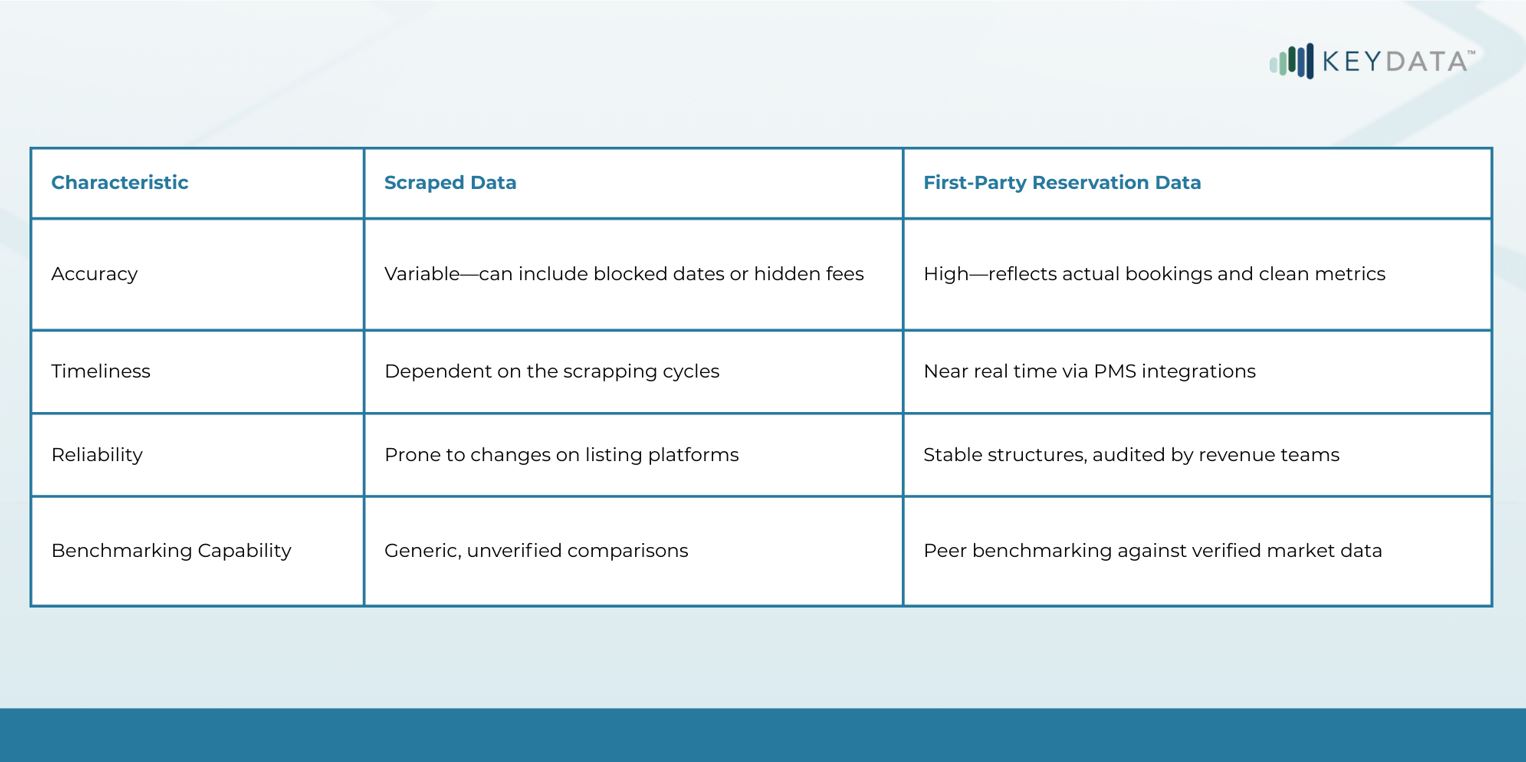
- Scraped OTA Data
- Scraped data comes from public listings—like rates and availability on Airbnb or Vrbo—and surface-level metrics such as calendar gaps.
- It’s convenient, but often inaccurate.
- Many listing platforms display disabled nights the same as sold nights, while some include hidden fees in advertised prices.
- Relying on this data risks skewed occupancy and revenue figures, especially when website structures or listing conventions change.
- First-Party Reservation data
- First-party reservation data, also known as direct data, is the gold standard.
- It's collected directly from PMS systems via secure integrations, reflecting actual booked nights, ADR, cancellations, and owner stays.
- That makes the data accurate, timely, and actionable—especially when benchmarks and trends matter.
- Key Data’s platform uses direct-source data to power trusted insights, not just estimates.
Building a Data-Driven Culture as a Property Manager
Turning insights into growth is about embedding analytics into your team’s daily rhythm. Here’s how you can level up and make data an engine of smarter operations:
- Regular KPIs Reviews
- Use your weekly or monthly team meetings to spotlight key performance metrics, such as ADR, pacing, or booking window.
- Discuss trends, celebrate improvements, and flag underperformance with data.
- When data drives the narrative, strategy becomes more agile and responsive.
- Share Access to Dashboards
- Give your team real-time access to dashboards tailored to their roles—front desk, ops, or marketing.
- When each team member sees their work's impact on occupancy, revenue, or guest satisfaction, decision-making becomes faster, and ownership grows.
- Establish Strong Communication with Owners
- Impress the homeowners by giving them regular updates on the most recent insights.
- Data-backed explanations and clear communication of performance build transparency and trust.
- Retention follows when metrics back your strategy.
- Track, Analyze, and Adjust
- Set a cycle where KPIs are tracked daily, reviewed weekly, and tweaked monthly.
- This creates a continuous feedback loop of identifying trends, testing prices, or marketing changes.
- Practices like this can turn analytics from a report function into a growth strategy.
Better Data, Better Decisions, Stronger Results
Vacation rental analytics are essential if you’re aiming to stay competitive in today’s market. Success depends on tracking the right metrics, leveraging tools that deliver actionable insights, and trusting data sources that reflect accurate facts.
First-party reservation data, paired with market benchmarking, ensures accurate, timely, and transparent decisions. With these insights, you can optimize pricing, improve owner retention, and confidently plan growth strategies.
Want to see how your properties stack up? Get in touch with us and learn how Key Data helps property managers unlock actionable insights and outperform the market.